Too Many Trading Indicators? How to Simplify Your Setup and Build Confidence
I used to stack indicators to feel “safer.”
MACD, RSI, VWAP, EMA cluster, momentum overlays, custom scripts — and somehow I was less confident, not more.
The issue was not effort. It was conflict. Too many signals means you can always find a reason to hesitate.
My story: my charts looked like a Christmas tree
At one point I had five indicators, three moving averages, and two oscillators fighting for attention. I kept adding tools because I thought more information meant more certainty. What it actually created was paralysis — I could justify any trade because some indicator always agreed.
The breakthrough came when I stripped everything down to price, volume, and one volatility marker. Suddenly the chart felt readable again. My entries got cleaner because I wasn’t waiting for seven lights to turn green, and my exits were based on structure instead of noise.
Simplicity didn’t make trading easier. It made it clearer.
Where I am now: My screen is quiet, and my decisions are louder.
Quick visual: the workflow at a glance
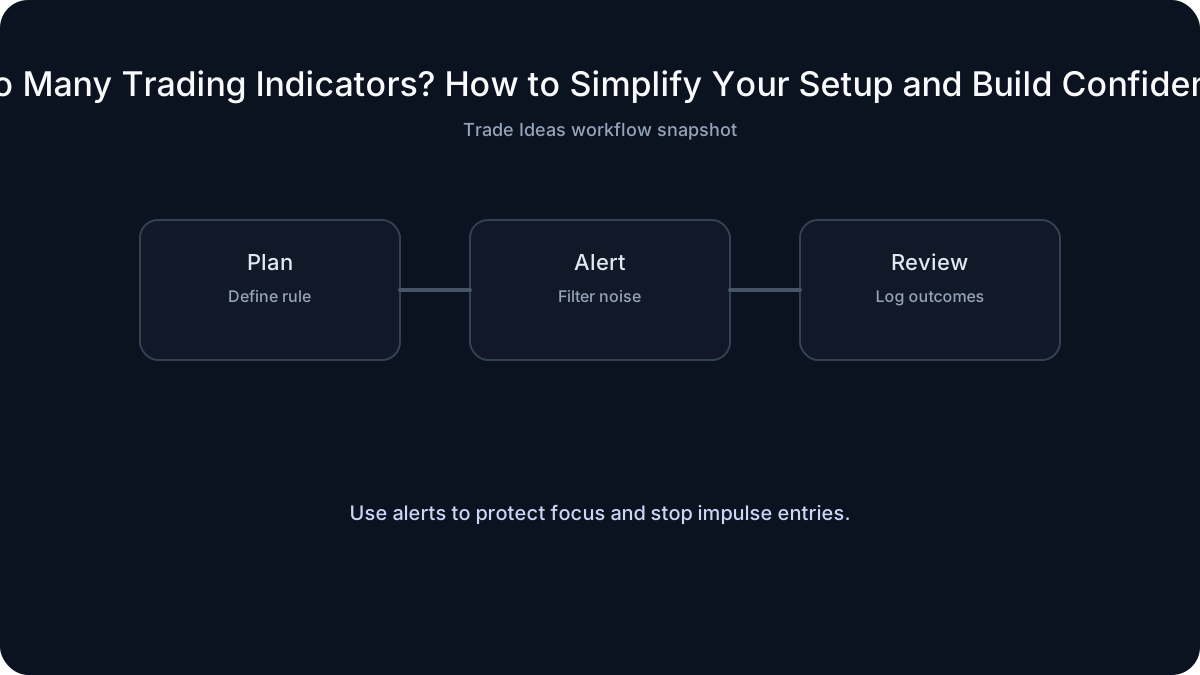
How to use it: - Plan the rule before the open (entry, risk, exit). - Alert only for setups that match the rule. - Review what fired and whether you followed the rule.
Why indicator overload hurts execution
When every indicator says something different:
- Entries become late
- Exits become random
- Risk management gets overridden
- You stop learning what actually works
Clarity beats complexity in short-term execution.
The simplification model that worked for me
Use one core setup with one market condition and one risk model.
Step 1: Pick one setup
Examples: - Opening range continuation - VWAP pullback - Breakout retest
Choose one and commit for 2 weeks.
Step 2: Keep only decision-critical inputs
For short-term trading, that is often:
- Price structure
- Volume/liquidity
- Time-of-day context
Everything else must earn its place.
Step 3: Lock risk rules
- Fixed risk per trade
- Hard invalidation level
- Session max loss rule
No indicator should overrule risk rules.
The 14-day consistency test
For two weeks:
- Do not change setup type
- Do not add indicators
- Log every trade with setup quality and rule adherence
- Review at end of week 2
If results are weak, adjust one variable at a time. If results improve, keep the model stable and refine execution.
Scanner alignment: let tools enforce focus
Instead of adding more chart clutter, define scanner criteria that match your one setup lane. That removes 80% of noise before you even decide.
If you want a practical example, start here: Trade Ideas review.
Common mistakes when simplifying
- Simplifying today, then changing everything tomorrow
- Removing indicators but keeping poor risk habits
- Measuring only P/L instead of execution quality
Simplicity only works if you stay consistent long enough to get signal from your data.
FAQ
How many indicators should I use?
As few as needed to make decisions consistently. For many traders, 2–4 decision-relevant inputs are enough.
Is simplification only for beginners?
No. Advanced traders simplify aggressively because speed and repeatability matter more than “more information.”
What if my strategy stops working?
Adjust one variable at a time (market condition, trigger threshold, or risk parameter). Do not rebuild the entire stack overnight.
Final thought
Most traders do not have an indicator problem. They have a decision conflict problem.
Simplify your setup, lock your risk rules, and trade the same process long enough to learn.
If you want cleaner execution with less chart noise, compare options here: Trade Ideas pricing and Trade Ideas plans.
Risk disclosure: Trading involves risk. Past performance is not indicative of future results.
Next step
Pick the right Trade Ideas plan
If you're ready to decide, start with the review and then compare pricing + plans.
